

Agra, Khajuraho, Varanasi and Darjeeling
03/03/2011We left Bundi via the first of three consecutive overnight trains, first to Agra to see the Taj Mahal, then to Khajuraho and finally to see the Ganges at Varanasi.
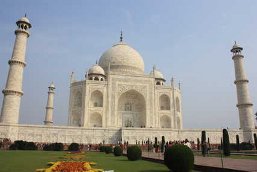 We arrived in Agra very early in the morning (still dark) so headed to
a roof top restaurant we read about that overlooked the Taj Mahal and
watched the sun rise. The sun wasn't behind the Taj Mahal which I am
sure would have been the most impressive angle to watch it at but it
was still great to watch the fog slowly clear and the light gradually
change bringing the magnificent building into view. It really is
exactly what you see in the photos but it was wonderful to see. After
breakfast we headed into the grounds to see it close up and take the
mandatory photos of the Taj Mahal reflected in the waters in front.
Beautiful. We had a guide who told us little that we hadn't read but
was about to point out one or two things and made us appreciate the
amazing workmanship that much more closely. After this we took a cycle
rickshaw to see Chiki-Ka-Rauza (a Persian-style tomb by the river is
fairly poor condition) and Itmad-Ud-Daulah aka the Baby Taj which was
actually built before the Taj Mahal and really is a small version of it
(or rather the Taj Mahal is a large version of it). It was beautiful
and very peaceful too. Finally we went back to the river to take a
photo of the Taj Mahal from across the river before letting our long
suffering rickshaw driver take us back to where we began. We then
spent the rest of the afternoon relaxing and sleeping by the pool of an
expensive hotel as Agra itself really isn't particularly nice or
exciting once you have seen the Taj Mahal (we missed out Agra fort from
our itinerary having felt that we had seen enough forts in Rajasthan and
they were starting to all look the same).
We arrived in Agra very early in the morning (still dark) so headed to
a roof top restaurant we read about that overlooked the Taj Mahal and
watched the sun rise. The sun wasn't behind the Taj Mahal which I am
sure would have been the most impressive angle to watch it at but it
was still great to watch the fog slowly clear and the light gradually
change bringing the magnificent building into view. It really is
exactly what you see in the photos but it was wonderful to see. After
breakfast we headed into the grounds to see it close up and take the
mandatory photos of the Taj Mahal reflected in the waters in front.
Beautiful. We had a guide who told us little that we hadn't read but
was about to point out one or two things and made us appreciate the
amazing workmanship that much more closely. After this we took a cycle
rickshaw to see Chiki-Ka-Rauza (a Persian-style tomb by the river is
fairly poor condition) and Itmad-Ud-Daulah aka the Baby Taj which was
actually built before the Taj Mahal and really is a small version of it
(or rather the Taj Mahal is a large version of it). It was beautiful
and very peaceful too. Finally we went back to the river to take a
photo of the Taj Mahal from across the river before letting our long
suffering rickshaw driver take us back to where we began. We then
spent the rest of the afternoon relaxing and sleeping by the pool of an
expensive hotel as Agra itself really isn't particularly nice or
exciting once you have seen the Taj Mahal (we missed out Agra fort from
our itinerary having felt that we had seen enough forts in Rajasthan and
they were starting to all look the same).
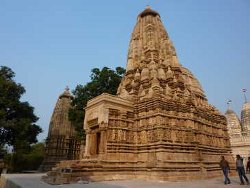 Next stop was Khajuraho. This is a small village really that has grown
into the size of a town due to the temples there and the tourists
theses inevitably attract. Originally there were 85 temples here
built between AD 950 and 1050 (yes, I am checking my facts with the
guide book!), about 25 still exist and we visited about 15 or so of
these. As you would expect they are in various states of decay, some
are really quite well preserved and others have been reconstructed with
just a few of the original stones in place. The significance of these
temples though, apart from the number, condition and age, is the
amazing sculptures around the inside and outside walls, many of which
appear to be based on the Kama Sutra (we thought the Kama Sutra book
was based on these temples but further reading it seems likely that if
there is any actual connection, it is that the temple work is based on
the book but the reality is there is no definite connection between the
two). The sculptures where amazing and, at least in some cases,
extremely well preserved especially when you consider the much newer
temples we have seen in places like Hampi and Rajesthan, although these
ones were protected from Muslim desecration because they were so
isolated and hidden in jungle.
Next stop was Khajuraho. This is a small village really that has grown
into the size of a town due to the temples there and the tourists
theses inevitably attract. Originally there were 85 temples here
built between AD 950 and 1050 (yes, I am checking my facts with the
guide book!), about 25 still exist and we visited about 15 or so of
these. As you would expect they are in various states of decay, some
are really quite well preserved and others have been reconstructed with
just a few of the original stones in place. The significance of these
temples though, apart from the number, condition and age, is the
amazing sculptures around the inside and outside walls, many of which
appear to be based on the Kama Sutra (we thought the Kama Sutra book
was based on these temples but further reading it seems likely that if
there is any actual connection, it is that the temple work is based on
the book but the reality is there is no definite connection between the
two). The sculptures where amazing and, at least in some cases,
extremely well preserved especially when you consider the much newer
temples we have seen in places like Hampi and Rajesthan, although these
ones were protected from Muslim desecration because they were so
isolated and hidden in jungle.
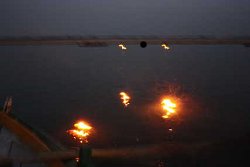 From temples to gaits on the Ganges though, we arrived in Varanasi
after the last of our 3 nights on trains. Varanasi is famous for it's
significance to the Hindus and the banks of The Ganges here is lined by
Ghats (steps down to the river) which are used for washing (humans and
clothes), swimming, religious ceremony and cremation. Oh, and being
India of course the untreated sewage of the city is also emptied
directly into the river, actually upstream of most of the main Ghats...
The burning Ghats (where the cremations take place) are very moving.
There is no sense of emotion here (apparently it is very bad to cry
when a relative is being cremated here) but there is a huge sense of
respect and ceremony around the very public event. It is believed that
people who are cremated here will not be reincarnated so it is a very
positive thing to be lucky enough to die here and in fact there is a
larger then normal proportion of old people in this town as they come
here specifically to make sure they do die here.
From temples to gaits on the Ganges though, we arrived in Varanasi
after the last of our 3 nights on trains. Varanasi is famous for it's
significance to the Hindus and the banks of The Ganges here is lined by
Ghats (steps down to the river) which are used for washing (humans and
clothes), swimming, religious ceremony and cremation. Oh, and being
India of course the untreated sewage of the city is also emptied
directly into the river, actually upstream of most of the main Ghats...
The burning Ghats (where the cremations take place) are very moving.
There is no sense of emotion here (apparently it is very bad to cry
when a relative is being cremated here) but there is a huge sense of
respect and ceremony around the very public event. It is believed that
people who are cremated here will not be reincarnated so it is a very
positive thing to be lucky enough to die here and in fact there is a
larger then normal proportion of old people in this town as they come
here specifically to make sure they do die here.
That said, the religious significance of this city and river does not make Varanasi and peaceful and quiet place. In fact arriving was a very stressful time with so many rickshaw drivers trying to over charge us and lie to us; the restaurants all added a different amount of "tax" to every bill and the hygiene levels were amongst the lowest we have seen (we saw one restaurant sign saying "yes, we are less dirty!" and Seth had a mouse run up his back in one restaurant we ate at which is actually recommended as one of the best in town, the waiter just watched the mouse for a while before commenting that it was very small and going back to wipeing the cutlery with the dirty cloth).
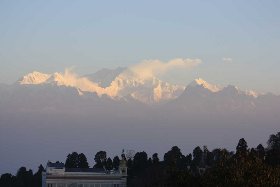 So after 3 nights there is was time to move on again now we are in Darjeeling. Darjeeling is very unlike the rest of India - and in deed they have been fighting with India for independence for the last 40+ years. It is clean, quite and cold (it is 2134 meters above sea level) and our hotel room bathroom had the most amazing view from the bathroom! We hardly heard the horns from the cars/bikes/rickshaws at all, the dogs don't bark and after 3 days I was never asked for my photo to be taken or been followed by anyone. In short it is a beautiful oasis and a wonderful place to end our time in India. We saw the snow topped mountains in the distance, walked to the top of a hill called tiger hill and went on a steam train. All very peaceful and happy times.
